01 / MODEL
Define the adversary
Turn “encrypt this” into assets, trust boundaries, oracle access, winning events, and failure consequences.
threat modelsMove from calling cryptographic APIs to defining adversaries, reading security claims, tracing protocol assumptions, and recognizing where real implementations fail.
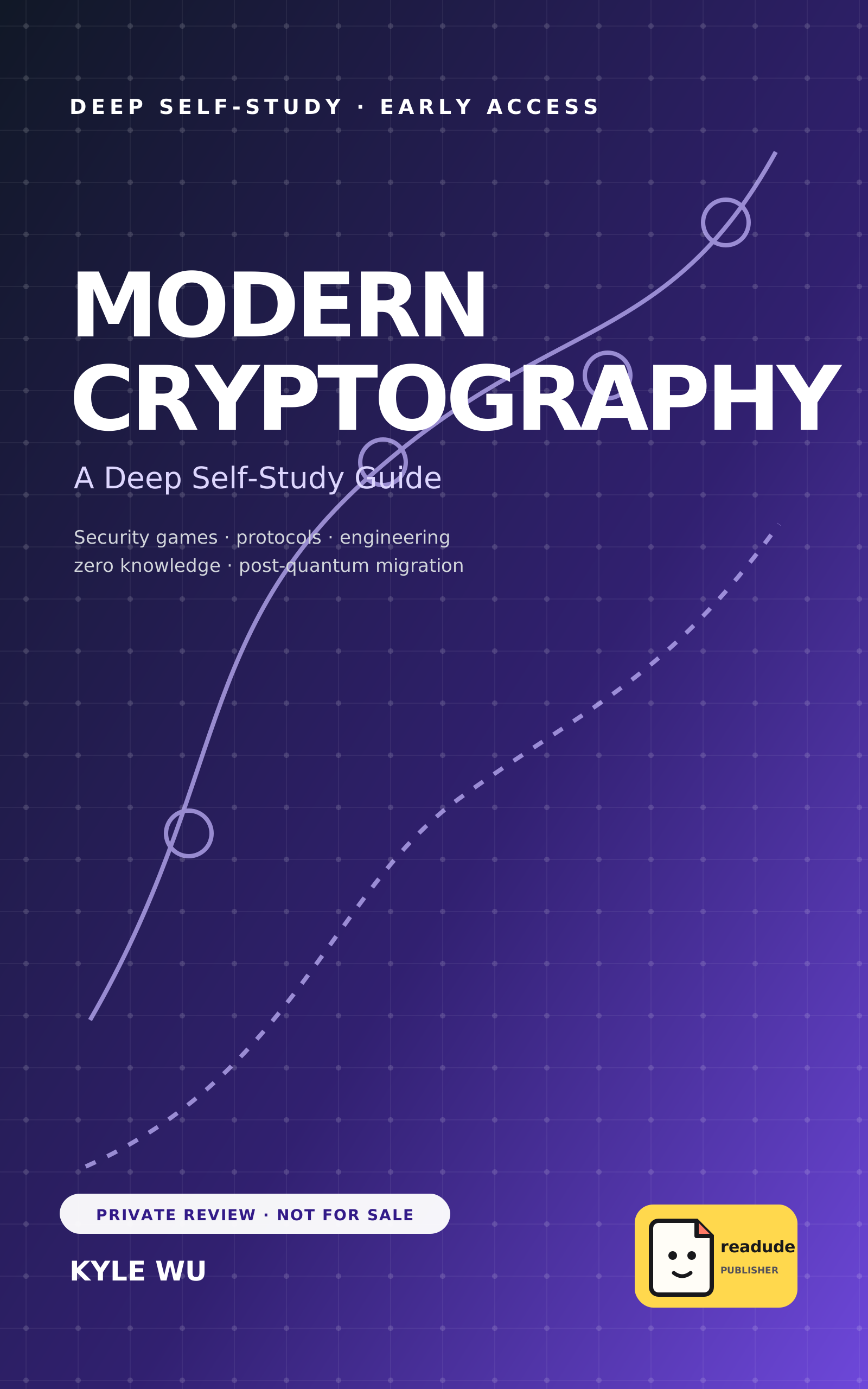
The English v1.0.0-rc.3 sample includes the front matter, Preface, study guide, Chapter 0, and Chapter 1. It is public-safe evaluation content—not the full book or paid companion bundle.
The book joins mathematical definitions to protocol and engineering boundaries instead of treating cryptographic primitives as isolated names.
Turn “encrypt this” into assets, trust boundaries, oracle access, winning events, and failure consequences.
threat modelsWork with indistinguishability, unforgeability, hybrid arguments, reductions, concrete loss, setup assumptions, and composition.
security gamesInspect nonce state, framing, canonicalization, replay, domain separation, parser ambiguity, key lifecycle, side channels, and migration.
engineeringEach part supplies prerequisites for the next. Follow the full route or use the accelerated and zero-knowledge-focused paths.
Threat models, security properties, Kryptos as a verification case study, and the classical cryptanalysis workbench.
Modular arithmetic, groups, fields, probability, entropy, birthday bounds, security games, and reductions.
AES, ChaCha20, AEAD, hashes, MACs, KDFs, RSA, Diffie–Hellman, ECC, and signatures.
HPKE, PKI, TLS 1.3, X3DH, Double Ratchet, HSM/KMS, sharing, and threshold signatures.
Commitments, Sigma protocols, R1CS, sumcheck, KZG, IPA, FRI, SNARKs, STARKs, recursion, and zkVMs.
Wallet security, incident analysis, cryptographic engineering, agility, and post-quantum migration.
 readude note
The manuscript was developed and translated with AI-assisted tools. The author is responsible for selection, organization, verification, editing, and release. Automated structure tests and passing educational examples do not constitute peer review, a cryptographic audit, or production approval.
Status: PRIVATE REVIEW · SALES DISABLED
The founding price is planned at US$9.99. After 14 days from the actual public launch, the same product moves to US$14.99. Nothing on this private-review site is a public offer.
Simplified Chinese is experimental and excluded from the initial Beta and paid bundle. Preferred checkout: Dodo Payments Overlay. Category fit is confirmed; final compliance approval is pending.
It rebuilds prerequisites, but it aims beyond introductory API usage. High-school algebra and basic Python are helpful; the complete route is comparable to a demanding university self-study sequence.
No. Examples are educational. Some intentionally expose failure modes or use toy parameters. Real systems require reviewed libraries, deployment profiles, key management, test vectors, and independent security review.
Yes. AI-assisted tools contributed to drafting, organization, and English translation. Human editing, primary-source checks, and beta issue triage are tracked. Claims of fully human translation, peer review, or audit are prohibited.
Readude is Kyle Wu's independent digital publishing brand for serious ideas across technical and non-technical fields. readude.com is the canonical live site; public sales remain gated and disabled.
This is a private-review build. Dodo formal approval, KYC and payout, product setup, the invited beta, zero known Critical issues, device QA, transaction lifecycle validation, and R2 must pass before payment is enabled.